

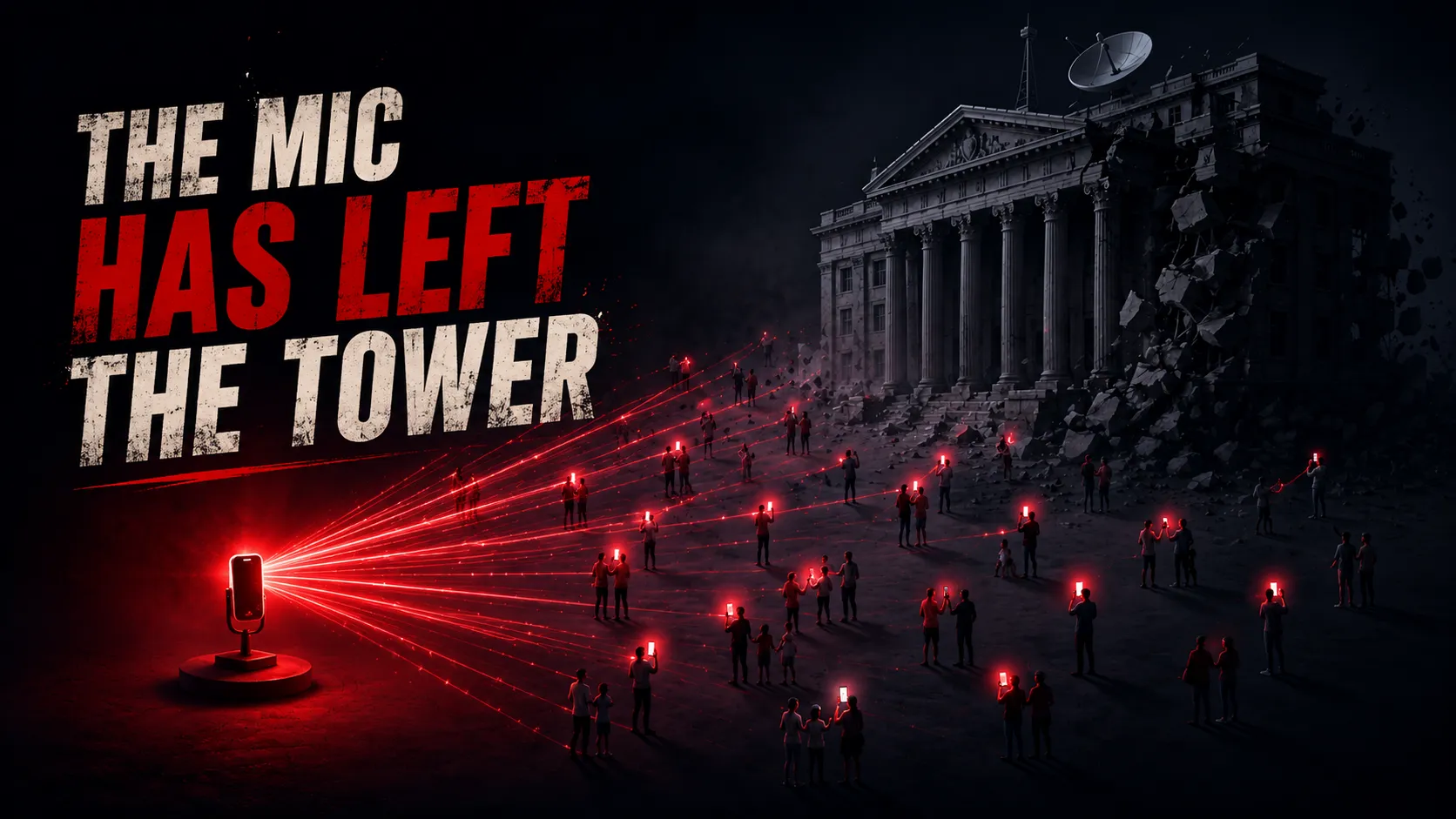
For most of the twentieth century, the right to broadcast was functionally a property of institutions. You needed a license, a tower, a studio, a regulatory relationship, and capital in the hundreds of thousands to reach an audience at scale. The result was a media landscape that was, by structural necessity, narrow: a small number of voices, reaching a large number of people, through a small number of channels.
That structure is being dismantled.
Today, a school district in rural Kenya streams its board meetings live to parents on YouTube. A competitive fishing guide in Minnesota publishes daily instruction to 40,000 subscribers and earns more from that audience than the local television station earns from its morning show. A parish in the Philippines reaches its diaspora congregation across three continents every Sunday through a browser-based multistreaming setup that costs under thirty dollars a month. A labor organizer in South Carolina distributes breaking updates to 15,000 followers through a combination of TikTok Live, Substack, and Discord, with no media credential, no publicist, and no institutional backing.
None of these people call themselves broadcasters. But by every functional definition, that is exactly what they are.
This report analyzes the structural, technological, economic, and social forces behind what is now a coherent and accelerating phenomenon: micro-broadcasting, defined as the production and distribution of live or on-demand audio and video content by individuals, small teams, and community organizations to targeted audiences, at costs and complexities previously unavailable to non-institutional actors.
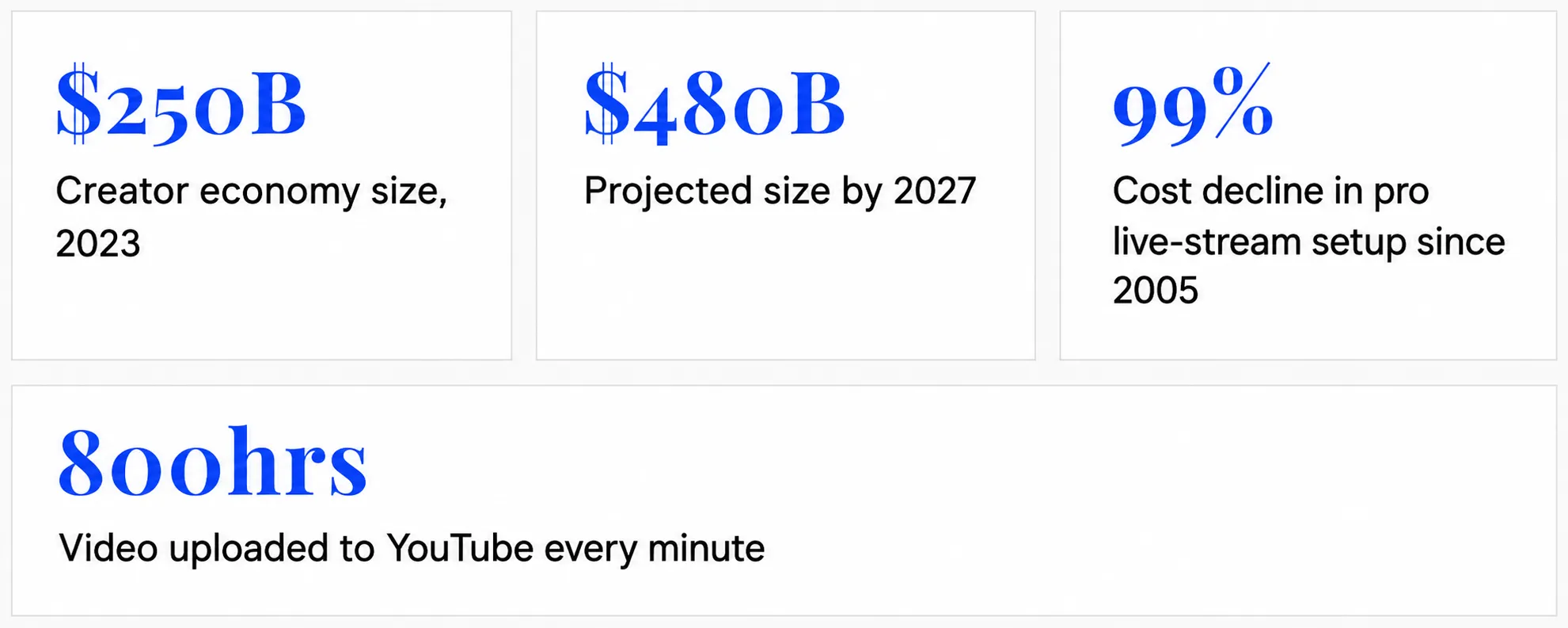
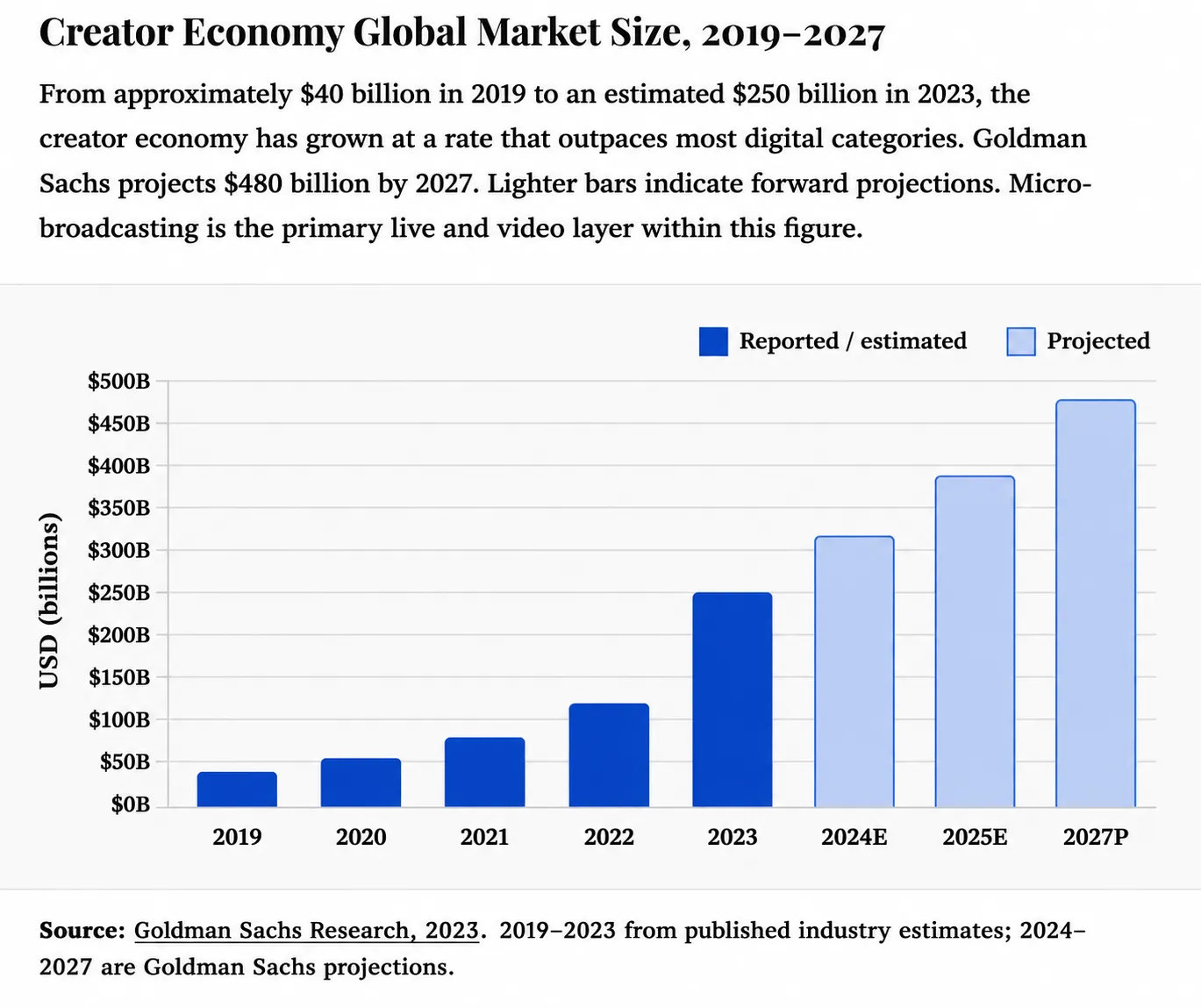
Micro-broadcasting is not a niche. In aggregate, it is the dominant form of video content production on the internet. YouTube alone hosts more than 800 hours of uploaded video per minute. Twitch streams more live content hours in a single day than most national television networks produce in a year. The creator economy, within which micro-broadcasting sits as a core pillar, was estimated at approximately $250 billion globally as of 2025, with projected growth toward $480 billion by 2027, according to Goldman Sachs research.
Key Findings
- Micro-broadcasting is not a trend emerging from the creator economy. It is the creator economy's primary output mechanism, and it predates the "creator" framing by nearly two decades.
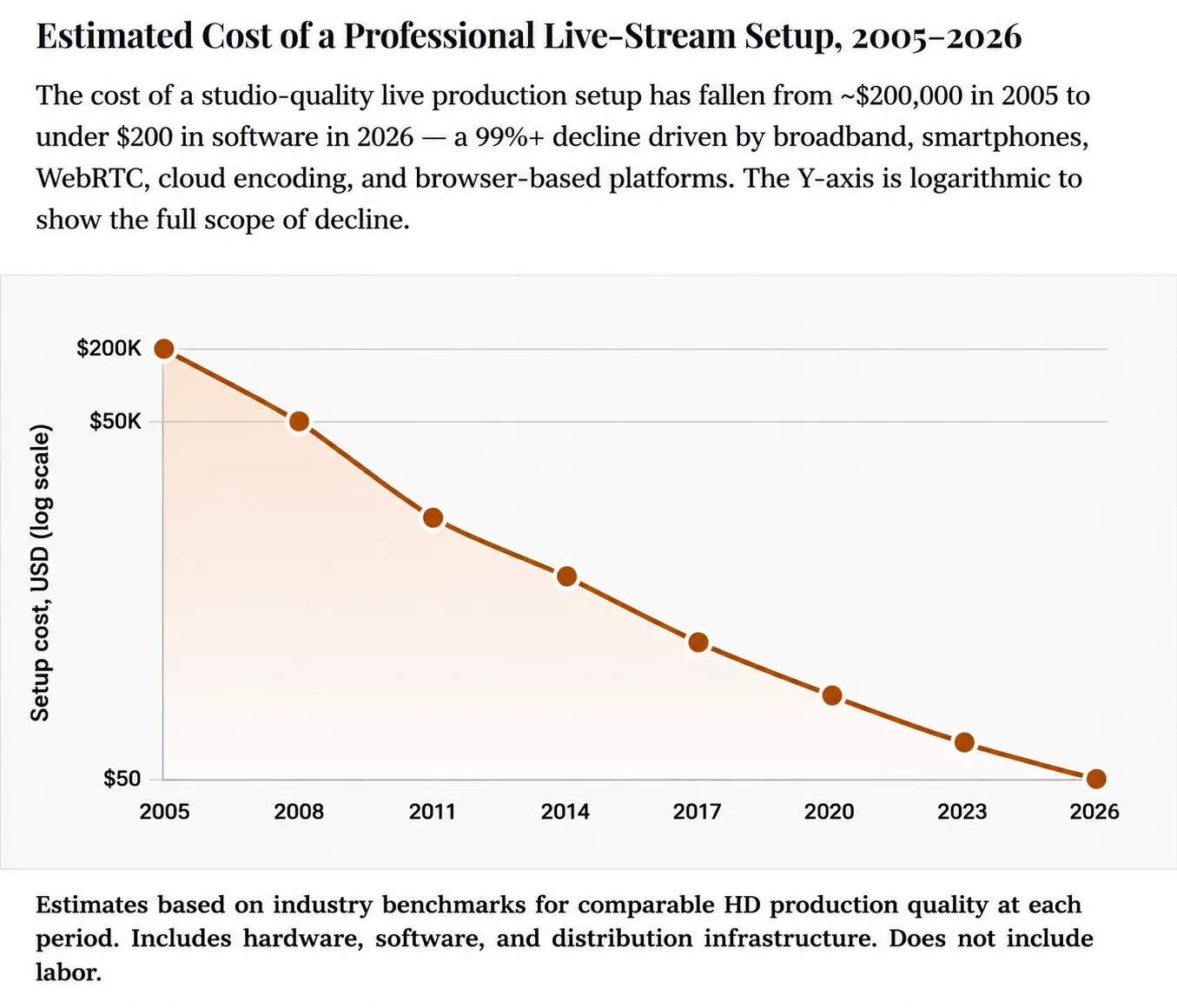
- The cost curve for professional-quality live video production has declined by more than 99 percent over twenty years. What required a $200,000 studio in 2005 can be replicated with $500 in hardware and $50/month in software in 2026.
- The platforms enabling micro-broadcasting (YouTube Live, Twitch, Facebook Live, TikTok Live, Instagram Live, Kick) are structurally motivated to support micro-broadcasters because micro-broadcasters generate content that platforms monetize through advertising and subscriptions.
- Traditional broadcast institutions are not competing with individual micro-broadcasters. They are losing structural relevance to the aggregate of micro-broadcasting: a disaggregated, highly specific, highly targeted media landscape in which the sum of many small audiences exceeds the reach of large ones.
- The technologies most responsible for micro-broadcasting's rise are not cameras or microphones. They are WebRTC (enabling real-time, low-latency browser-based video), CDN infrastructure (enabling global distribution at scale), and cloud-based production tools (eliminating the hardware studio).
- AI is entering micro-broadcasting not as a replacement for human creators but as a production equalizer, compressing the capability gap between professional studios and individual operators.
- The regulatory frameworks governing broadcast media in most jurisdictions were designed for a world in which distribution capacity was scarce. They are poorly equipped to handle a world in which it is effectively unlimited.
- Trust is the central unsolved problem of micro-broadcasting. Platform-level verification, audience-level media literacy, and regulatory intervention are each partial and incomplete responses.
What Is Micro-Broadcasting?
Micro-broadcasting is the production and distribution of audio, video, or multimedia content by individuals, small teams, or community organizations, using digital infrastructure to reach targeted audiences directly, without the intermediation of traditional media institutions. It encompasses both live streaming and on-demand publishing, and it is distinguished from traditional broadcasting by its cost structure, production scale, audience specificity, and direct creator-to-audience relationship.
Micro-broadcasting differs from user-generated content in its intent and continuity. A person uploading a viral video once is not a micro-broadcaster. A person who consistently produces, distributes, and cultivates an audience around a specific subject, using video or audio as the primary medium, is.
The "micro" prefix refers to the organizational scale of the producer, not the scale of the impact or the audience. A micro-broadcaster is an individual or small team. The audience can range from two hundred hyper-engaged community members to ten million subscribers, though the median audience for active micro-broadcasters is far smaller: most research on YouTube channel distributions suggests that channels with fewer than 100,000 subscribers account for the overwhelming majority of content produced.
Historical Evolution
The Radio Era (1920s to 1950s)
Broadcasting began as an essentially public activity before it became an institutional one. Early radio in the 1920s was populated by amateur operators, religious communities, educational institutions, and local merchants who purchased or constructed transmitters and built audiences organically. The federal government moved to regulate spectrum allocation in the United States through the Radio Act of 1927 and the Communications Act of 1934 precisely because the medium had become too economically and politically valuable to leave unstructured.
The regulatory response created a class of licensed broadcasters who were, almost by definition, institutions: they had the legal standing, the capital, and the organizational capacity to navigate the licensing regime. Individual voices continued to exist in radio, but as employees of licensed stations, not as independent distributors.
The Cable Era (1970s to 1990s)
Cable television appeared to offer a potential corrective. The cable franchise system, which granted local monopolies in exchange for the buildout of cable infrastructure, created an obligation to offer "public access" channels: low-cost or no-cost distribution to community members who wanted to produce their own programming. Public access television produced a generation of micro-broadcasters before the term existed: local political commentators, community organizations, religious groups, and individual eccentrics who produced weekly programs for local audiences.
The public access model was meaningful but severely constrained. Distribution was geographic, capped to cable subscribers in a given franchise area. Production equipment was limited and shared. Scheduling was controlled by the cable operator. The audiences were small, the production values were low, and the feedback loops between creators and audiences were slow or nonexistent.
The Early Internet Era (1993 to 2005)
The first generation of the internet created the infrastructure for text-based micro-broadcasting: anyone with a web connection and basic HTML skills could publish globally. The implications were significant for journalism and opinion, but video was impractical. Bandwidth constraints meant that even short video clips were painful to distribute and consume. Streaming audio was possible in a degraded form through tools like RealPlayer, but the experience was unreliable and the reach was limited.
The rise of broadband internet in the late 1990s and early 2000s began to change the calculation. By 2005, a meaningful fraction of American households had DSL or cable internet connections sufficient to watch compressed streaming video, even if the quality was low by television standards.
The Streaming Era (2005 to 2014)
YouTube launched in February 2005 and was acquired by Google in October 2006 for $1.65 billion. Its arrival did not immediately create the conditions for micro-broadcasting as it exists today. Upload limits, quality constraints, and monetization structures were primitive. But YouTube solved the distribution problem: any person with a video file and an internet connection could reach a global audience for free.
Ustream and Justin.tv (later Twitch) introduced live streaming to the consumer internet between 2007 and 2011. The initial use cases were eclectic: personal lifecasting, political events, protests. The Arab Spring of 2010 to 2012 demonstrated, for the first time at a global scale, that live video could be produced from a smartphone and distributed to a global audience in real time, with political consequences.
Twitch launched as a gaming-focused spinoff of Justin.tv in 2011 and was acquired by Amazon in 2014 for $970 million. Its acquisition signaled that live video content produced by individuals was an economically serious business.
The Creator Era (2014 to 2021)
The period from 2014 to 2021 saw the formalization of the creator economy as a distinct economic structure. YouTube introduced the Partner Program, eventually making advertising revenue sharing available to channels that crossed threshold audience sizes. Patreon launched in 2013, enabling direct creator-to-fan financial relationships outside platform advertising. Substack launched in 2017 for text, and the model of audience-supported, creator-owned distribution channels extended to video and audio.
By 2020, the COVID-19 pandemic forced a mass acceleration of the trend. Religious organizations that had never considered live streaming began distributing services via YouTube Live and Facebook Live within weeks of March 2020. Schools attempted live broadcasting through Zoom. Small businesses pivoted to video commerce. The constraints of physical gathering removed the alternative and compelled institutions and individuals alike to reckon with digital distribution as not a supplementary channel but a primary one.
The Micro-Broadcasting Era (2021 to Present)
By 2021, micro-broadcasting had become structurally distinct enough to warrant its own analysis. The combination of platform maturity, monetization infrastructure, AI-assisted production tools, and browser-based streaming technology had reduced the barriers to competent live video production to near zero. The emergence of platforms like Yostream, which enables multi-platform simultaneous live streaming directly from a web browser without dedicated software installation, exemplifies the endpoint of this cost compression: a complete live production and multistreaming workflow, available through a browser tab, at a fraction of the cost of comparable professional tools available a decade earlier.
The micro-broadcasting era is characterized not by novelty but by normalization. Live streaming is now a default content format rather than a specialized one. The question is no longer whether to micro-broadcast, but how, for whom, and toward what end.
Broadcasting Eras at a Glance
| Era | Period | Primary Distribution | Entry Barrier | Individual Access |
|---|---|---|---|---|
| Radio | 1920s–1950s | AM/FM spectrum | Federal license + transmitter ($50K–$500K) | Virtually none |
| Cable | 1970s–1990s | Coaxial cable franchise | Cable operator approval + shared studio | Limited (public access only) |
| Early Internet | 1993–2005 | Web publishing (text/audio) | HTML skills + hosting ($0–$100/month) | Text only; video impractical |
| Streaming | 2005–2014 | YouTube VOD + early live | Broadband + camera + upload account | Free but unmonetized |
| Creator | 2014–2021 | Multi-platform VOD + live | Smartphone + platform account | Full access; monetization emerging |
| Micro-broadcasting | 2021–present | Browser-based multistreaming | Browser + $0–$50/month SaaS | Full access; AI-assisted production |
Technologies That Made Micro-Broadcasting Possible
Broadband Internet
The foundational enabling technology for micro-broadcasting is reliable, high-speed internet access. Live video distribution at adequate quality requires a minimum sustained upload bandwidth of roughly 3 to 5 Mbps for standard definition, and 6 to 15 Mbps for HD. The global expansion of broadband infrastructure, particularly in North America,https://yostream-prod-storage.storage.googleapis.com/media/images/live_stream_set_up.max-165x165.png Europe, and East Asia during the 2000s and 2010s, and the continued extension of fiber and 4G LTE networks into lower-income markets during the 2010s, made the technical precondition for micro-broadcasting available to a growing fraction of the world's population.
WebRTC
WebRTC (Web Real-Time Communication) is an open-source technology standard developed by Google and standardized by the World Wide Web Consortium (W3C) that enables peer-to-peer audio, video, and data communication directly within web browsers without plugins or native app installation. Before WebRTC matured, live streaming required either a dedicated hardware encoder or a native desktop application like OBS Studio. WebRTC enables browser-based tools like Yostream, StreamYard, and Riverside to deliver production-quality live streaming from within a browser tab, reducing the technical barrier to entry to near zero.
RTMP and CDN
RTMP (Real-Time Messaging Protocol), the de facto standard for delivering live video streams to a streaming server, created a degree of interoperability across platforms: a single encoded stream can be sent to multiple platforms simultaneously through a multistreaming relay service. Content Delivery Networks (CDNs) ensure that a stream originating from a single creator's connection can be delivered at adequate quality to viewers anywhere in the world. Edge computing is now reducing stream latency to sub-second levels, significant for real-time interactive use cases including live shopping and live Q&A formats.
Browser-Based Streaming Platforms
Platforms like StreamYard, Yostream, Riverside, and Restream enable a micro-broadcaster to manage guests, graphics, scene switching, multi-platform distribution, and real-time audience interaction from a single browser interface. OBS Studio remains the standard for technically proficient creators, having lowered the production software cost floor to zero with its free, open-source architecture and extensive plugin ecosystem.
| Technology | Core Role | Practical Since | Primary Barrier Removed |
|---|---|---|---|
| Broadband internet | Upstream bandwidth for live video | Early 2000s | Geographic and bandwidth constraints |
| Smartphones | Portable capture + production | 2008–2010 | Hardware cost (zero for phone owners) |
| WebRTC | Browser-native real-time video | 2012–2015 | Software installation requirement |
| RTMP | Universal platform ingest protocol | 2007 (widespread) | Per-platform encoder fragmentation |
| CDN infrastructure | Global delivery at scale | 2010s (platform-provided) | Distribution infrastructure cost |
| Cloud encoding | Server-side video processing | 2016–2018 | Local compute hardware requirement |
| Browser-based studios | End-to-end production in a tab | 2018–present | Technical expertise barrier |
| AI production tools | Automated quality and clip generation | 2022–present | Post-production labor cost |
The Creator Economy and Democratization of Media
The creator economy refers to the ecosystem of individuals who generate income primarily through digital content creation. Micro-broadcasting is the video and live content layer of the creator economy.
In the United States, adults aged 18 to 34 now spend more time per day watching YouTube than any traditional television network, according to Nielsen data. Among adults 18 to 24, YouTube reaches more people in a week than any cable news network. YouTube's Partner Program has paid out more than $70 billion to creators since 2007.
The democratization argument deserves scrutiny. It is accurate that the technical barriers to creating and distributing content have been dramatically reduced. It is less accurate that economic success is broadly distributed. The attention economy follows power-law distributions: a small fraction of creators earn the overwhelming majority of revenue, while the majority earn very little or nothing directly. Micro-broadcasting enables participation; it does not guarantee economic sustainability.
| Platform | Ad Revenue Share | Subscription Cut to Creator | Minimum Threshold | Primary Monetization Tools |
|---|---|---|---|---|
| YouTube Live | 55% AdSense | 70% of memberships | 1,000 subs + 4,000 watch hours | Super Chats, Channel Memberships, AdSense |
| Twitch | 50% standard; 70% for top partners | 50% of subscriptions | Affiliate: 50 followers | Bits, Subscriptions, Ads |
| Kick | Not disclosed | 95% of subscriptions | Open to all | Subscriptions, Clips |
| Facebook Live | ~55% (Stars program) | N/A | Fan Subscriptions require approval | Stars, Fan Subscriptions, In-Stream Ads |
| TikTok Live | Variable (gift-based) | N/A | 1,000 followers to go live | Gifts, LIVE Subscriptions, Series |
| LinkedIn Live | No direct revenue share | N/A | Approval-based access | Brand authority; no direct payment |
Micro-Broadcasting vs. Traditional Broadcasting
| Dimension | Traditional Broadcasting | Micro-Broadcasting |
|---|---|---|
| Entry cost | $100,000 to $10M+ (studio, equipment, licensing, distribution) | $0 to $5,000 (browser-based tools, smartphone, consumer hardware) |
| Distribution infrastructure | Owned or leased (tower, satellite, cable franchise) | Platform-provided (YouTube, Twitch, Facebook, Kick) |
| Regulatory requirements | FCC/Ofcom licensing, content regulations, equal time rules | Minimal formal regulation; governed by platform Terms of Service |
| Audience reach model | Geographic/demographic mass market | Topical niche; global but segmented |
| Production complexity | High (multi-person crew, specialized equipment) | Low to medium (solo to small team, consumer to prosumer equipment) |
| Time to publish | Hours to days (editing, review, scheduling, transmission) | Seconds to minutes (live) or hours (edited) |
| Audience interaction | Passive (phone-in shows are the primary exception) | Real-time (live chat, polls, Q&A, direct response) |
| Monetization model | Primarily advertising; secondarily licensing | Advertising, subscriptions, memberships, donations, merchandise, sponsorships |
| Content ownership | Station/network retains rights | Creator typically retains rights (platform-specific nuances apply) |
| Geographic constraint | Historically local or national | Inherently global |
| Feedback cycle | Ratings data (weekly, aggregated, approximate) | Real-time analytics (concurrent viewers, engagement rate, chat sentiment) |
| Scalability ceiling | Limited by transmission capacity | Effectively unlimited (CDN handles any audience size) |
| Talent development | Institutional (casting, contracts, development deals) | Self-directed; audience validation replaces institutional gatekeeping |
The comparison reveals that micro-broadcasting and traditional broadcasting are structurally different models with different audience relationships, different feedback mechanisms, different content rhythms, and different economic structures. The competitive pressure micro-broadcasting places on traditional broadcasting is not primarily in quality of production, though that gap is closing. It is in speed, specificity, interactivity, and economic efficiency.
Key Use Cases
Citizen Journalism
The live video documentation of protest movements, police interactions, natural disasters, and public events by individuals with smartphones has produced content that shaped public discourse and, in several documented cases, influenced legal outcomes. The Black Lives Matter movement from 2014 onward was documented extensively through citizen micro-broadcasting that preceded, and in some cases drove, professional news coverage.
Gaming and Esports
Gaming is the domain in which micro-broadcasting achieved its first large-scale economic validation. Twitch had more than 7 million active streamers as of 2024. Gaming micro-broadcasters monetize through platform subscriptions, in-platform currency, sponsorships from gaming hardware brands, and participation in esports event coverage.
Education
Educational micro-broadcasting encompasses university professors who stream supplementary lectures, independent subject-matter experts who build tutorial channels, school districts that broadcast board meetings, and tutoring services that deliver live instruction to remote students. YouTube's algorithm systematically surfaces educational content to users searching for specific skills, creating a durable discovery mechanism that traditional education cannot replicate.
Religious Organizations
Houses of worship were among the earliest institutional adopters of micro-broadcasting. The ability to maintain congregation connection across geography, serve homebound or diaspora members, and extend reach beyond the physical building has made live streaming a permanent part of religious practice for a large fraction of organized religious communities worldwide.
Political Communication
Politicians, advocacy organizations, and political movements use micro-broadcasting to communicate directly with supporters, bypassing the editorial mediation of traditional news coverage. Grassroots movements gain a communication channel previously unavailable to them, while established political actors gain the ability to communicate claims without fact-checking or editorial challenge. The new era of political communication help politicians build trust with their constituents.
Hyperlocal News and Local Sports
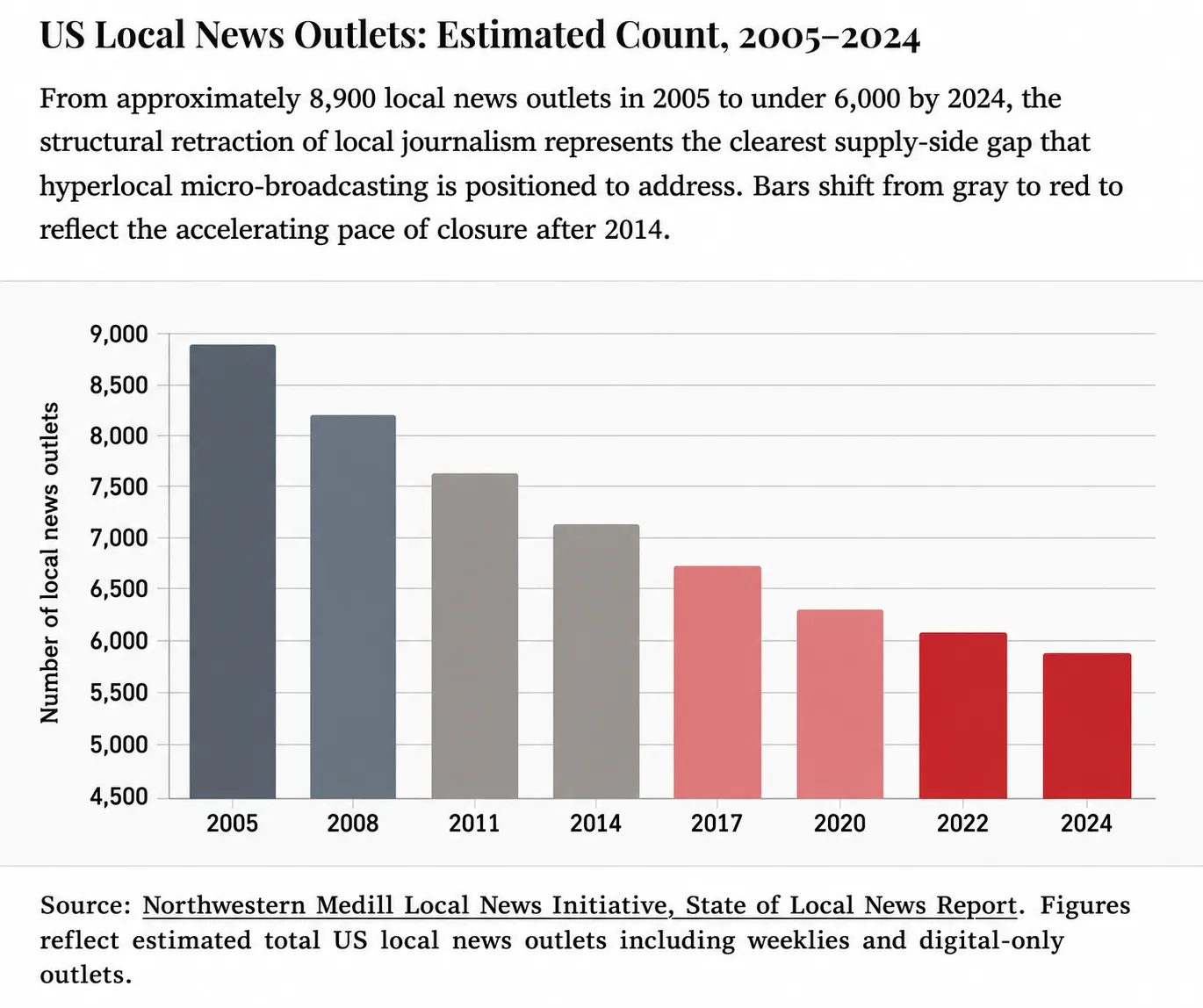
The collapse of local newspaper and television news coverage has created a gap that hyperlocal micro-broadcasters are beginning to fill. Local sports coverage, high school athletics, local government meetings, and community events are being documented by individual creators or small community organizations in markets where institutional media has withdrawn.
Corporate Communication and B2B
Organizations use micro-broadcasting for internal communication (all-hands meetings, leadership updates), external communication (product launches, investor relations events), and brand building. LinkedIn Live has become a significant channel for B2B micro-broadcasting.
NGOs and Civil Society
Non-governmental organizations use micro-broadcasting to document conditions in conflict zones and humanitarian crises, to organize and mobilize supporters, and to report directly to donor communities. Organizations operating in media-restricted environments use secure mobile streaming to distribute footage that would otherwise be inaccessible to the outside world.
Business Models in Micro-Broadcasting
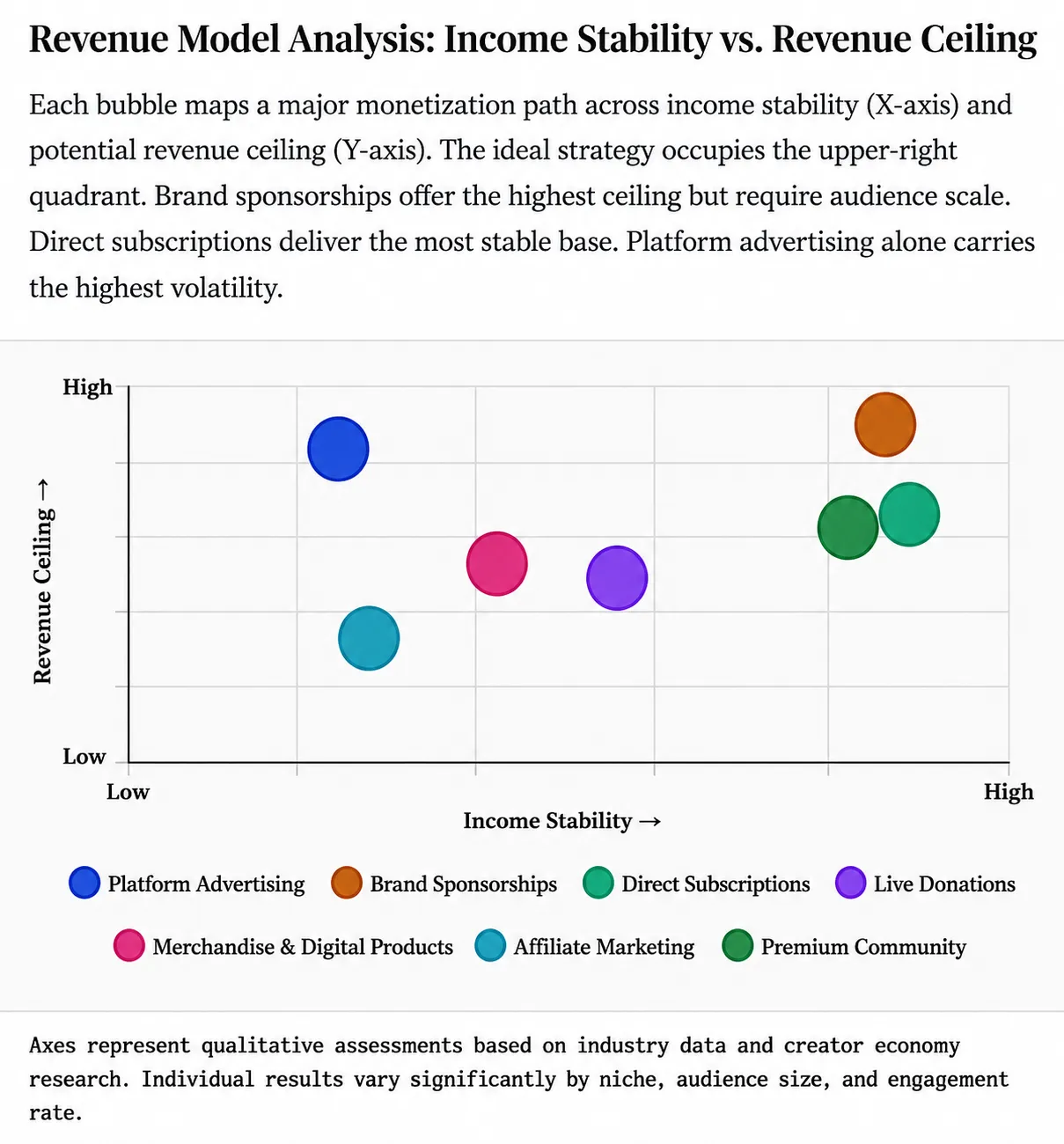
The economic sustainability of micro-broadcasting depends on matching the right monetization model to the right audience relationship.
| Revenue Model | Income Stability | Audience Scale Required | Setup Complexity | Revenue Ceiling |
|---|---|---|---|---|
| Platform advertising | Low (algorithm-dependent) | 50,000+ monthly views | Low | High at scale |
| Direct subscriptions | High | 500–2,000 paying fans | Low | Medium |
| Brand sponsorships | Medium | 5,000+ engaged live viewers | Medium | High |
| Live donations / Super Chats | Medium | 500+ concurrent viewers | Low | Medium |
| Merchandise & digital products | Low–Medium | 20,000+ loyal followers | Medium | Medium |
| Affiliate marketing | Low | 10,000+ monthly views | Low | Low–Medium |
| Premium community | High | 200–1,000 paying members | Medium–High | Medium |
Platform Advertising Revenue. YouTube's CPM (cost per mille) rates vary widely by content category: educational, financial, and technology content typically commands $10–$40+, while entertainment or gaming content earns $1–$5. Advertising revenue alone is economically viable only at substantial audience scale.
Memberships and Subscriptions. Direct audience subscriptions through independent platforms (Patreon, Memberful, Substack) represent the most durable revenue model because they are less dependent on algorithmic reach and platform policy than advertising.
Sponsorships. Brand sponsorships represent the largest single revenue stream for mid-to-large micro-broadcasters, negotiated directly between the creator and the brand. Sponsorship rates in the streaming industry typically range from $15 to $50 per thousand highly engaged viewers.
Premium Communities. Paid private communities (Discord servers with paywalled channels, Circle communities, Mighty Networks groups) represent a micro-broadcasting evolution toward community media: the broadcaster becomes a community convener, with content serving as both the primary value delivery mechanism and the lead generation channel for the premium membership.
The Role of AI in Micro-Broadcasting
Artificial intelligence is entering the micro-broadcasting production stack across multiple categories. Real-time AI tools now handle background replacement, noise suppression, and virtual camera enhancement within production interfaces. AI clipping tools (Opus Clip, Vidyo.ai) analyze streams for engagement signals and generate timestamped highlight candidates with minimal manual review. AI moderation systems scan live chat in real time for policy violations and spam. Automatic captioning is now handled at near-professional accuracy by AI systems embedded in most major platforms. AI translation extends this capability to multilingual audiences with real-time translated captions in dozens of languages.
| AI Application | Production Stage | Example Tools | Labor Cost Eliminated |
|---|---|---|---|
| Caption & transcription | Post-production | YouTube auto-captions, Whisper, Otter.ai | Manual transcription ($1–$3/minute) |
| Clip & highlight generation | Post-production | Opus Clip, Vidyo.ai, Riverside AI Clips | Video editing (2–6 hours per stream) |
| Background removal | Live production | OBS AI filter, StreamYard, Yostream | Physical studio or green screen setup |
| Noise suppression | Live production | NVIDIA RTX Voice, Krisp, Adobe Enhance Speech | Audio engineering and soundproofing |
| Live chat moderation | Live production | Streamlabs, CommanderRoot, platform-native AI | Dedicated moderator labor |
| Thumbnail & title optimization | Pre-production | TubeBuddy, VidIQ, Canva AI | Graphic design and SEO research |
| Real-time translation | Live production | YouTube Live captions, Wordly | Human interpreter fees |
| Content discovery optimization | Pre-production | VidIQ, TubeBuddy, Metricool | Keyword research and competitive analysis |
Original Analytical Frameworks
Framework 1: The Micro-Broadcasting Maturity Model
The Micro-Broadcasting Maturity Model describes the developmental stages through which individual micro-broadcasters and small organizations typically progress. It is useful not as a prescriptive ladder but as a diagnostic tool: understanding which stage an operator currently occupies clarifies which investments and priorities are appropriate.
Stage 1: Experimentation
The operator produces content without a defined audience, consistent format, or production standard. Output is irregular. Revenue is zero or incidental. The primary activity is learning the production workflow and discovering audience response.
Stage 2: Consistency
The operator establishes a production rhythm, a defined subject domain, and a baseline production standard. Audience growth becomes intentional. Basic monetization is activated. The primary challenge is maintaining consistency without external accountability structures.
Stage 3: Community
The broadcaster has an engaged audience that identifies with the content and creator. Live interaction is a regular part of the content experience. Monetization is beginning to generate meaningful supplemental income.
Stage 4: Media Business
Revenue is diversified. Production may involve contracted support (editors, thumbnail designers). The creator has a defined editorial identity, a business structure, and an audience that constitutes genuine intellectual property.
Stage 5: Platform
The broadcaster has developed a brand and content infrastructure that extends beyond a single platform or format. The operator functions as a media brand: licensing content, developing products, launching sub-channels, or extending into events, courses, or publishing.
Framework 2: The Creator-to-Media Company Framework
Most micro-broadcasters begin as individual creators and a meaningful subset evolve into what are functionally small media companies. The Creator-to-Media Company Framework identifies the specific inflection points at which individual creator behaviors become organizational bottlenecks.
Inflection Point 1: Content Capacity. The creator reaches an output volume that exceeds individual production capacity. The response options are: reduce output (risking audience loss), hire assistance, or develop more efficient production systems.
Inflection Point 2: Revenue Complexity. Multiple revenue streams require financial tracking, tax management, and contractual review that exceed the capacity of an informal operation.
Inflection Point 3: Audience Scale. At sufficient audience size, community management becomes a distinct operational function that conflicts with the time demands of content production.
Inflection Point 4: Brand Risk. A creator with a large audience has brand equity vulnerable to reputational events. Managing brand risk requires a formalized approach that most individual creators lack.
The Framework's central insight is that the skills required to succeed as an individual creator (authenticity, consistency, subject expertise) are not the same skills required to succeed as a media company operator (systems design, people management, financial planning, legal compliance).
Framework 3: The Community Attention Flywheel
The Community Attention Flywheel describes the self-reinforcing dynamic through which micro-broadcasters with strong community relationships generate compounding audience growth. Quality content attracts initial viewers, some fraction of whom become engaged community members. Community engagement increases watch time and session frequency, which improves algorithmic ranking and recommendation distribution. Improved distribution attracts new viewers, who are drawn partly by the visible existence of an engaged community as social proof of the content's value.
The Flywheel breaks under two conditions: inconsistency of output, or community-content misalignment when a creator pivots their subject focus without managing the community transition.
Framework 4: The Hyperlocal Media Advantage
Traditional local media operated at a geographic scale determined by the economics of physical distribution. Micro-broadcasting removes the geographic constraint from local media in both directions: a micro-broadcaster can distribute globally and simultaneously serve a community defined more precisely than geography — a profession, a hobby, an ethnic community, a disease, a religious tradition, a neighborhood, a school.
The United States has lost more than one-third of its local newspapers since 2005, according to Medill School of Journalism research. Each closed paper represents an addressable community audience without a consistent media voice.
Framework 5: The AI-Augmented Broadcaster Model
The AI-Augmented Broadcaster Model describes the capability architecture of a micro-broadcaster who fully integrates available AI tools into their production workflow, and the resulting capability gap that emerges between AI-augmented and non-augmented operators.
Pre-production: AI tools assist with topic research, title and thumbnail testing (A/B prediction models), and scheduling optimization.
Production: Real-time AI tools handle noise suppression, background management, caption generation, and live chat moderation during the stream itself.
Post-production: AI tools generate timestamped highlight clips, produce platform-specific edits (vertical for TikTok/Shorts, horizontal for YouTube), and generate transcripts for SEO-optimized descriptions.
Distribution: Multistreaming platforms like Yostream distribute simultaneously to multiple platforms through a single RTMP output, eliminating per-platform setup overhead. AI tools analyze platform algorithm signals to optimize metadata for each platform.
Analysis: AI-assisted analytics identify which content segments drove highest retention, which audience cohorts are most engaged, and which topics represent underserved demand.
The cumulative effect is that a single operator, using current tools, can produce content at a quality level, distribution volume, and data-informed optimization cadence that previously required a team of four to six people.
Economic Impact
The creator economy was estimated by Goldman Sachs at approximately $250 billion globally in 2023, with projections to approximately $480 billion by 2027. These figures represent income to creators rather than gross platform revenue. YouTube's advertising revenue in 2024 exceeded $36 billion, approximately two-thirds of which is shared with creators through the Partner Program.
Traditional media economic displacement is an equally real effect. US local television advertising revenue has declined from approximately $20 billion in 2014 to under $14 billion in 2024, in a period during which total digital video advertising spending grew from under $5 billion to over $65 billion. The structural competition for advertising attention is direct.
Social Impact
Information access. Micro-broadcasting has substantially expanded the availability of specialized, expert, and community-specific information to audiences previously underserved by mass media. Medical professionals, legal experts, engineers, historians, and subject specialists of every kind now distribute instructional content directly to interested audiences at no cost.
Political voice. Micro-broadcasting has given political voice to communities and individuals who were historically excluded from mainstream media representation. Immigrant communities, racial minorities, LGBTQ+ communities, and rural communities all have micro-broadcasting ecosystems that document their perspectives, concerns, and cultures with a fidelity and specificity that mass media has historically failed to provide.
Misinformation amplification. The same structural features that make micro-broadcasting a democratizing medium make it an effective vector for misinformation. Low production barriers mean low gatekeeping. The algorithmic recommendation systems that power content discovery optimize for engagement, and misinformation content frequently generates higher engagement than accurate but mundane content.
Community building. Micro-broadcasting has enabled the formation of communities around subjects, identities, and experiences that were previously too geographically dispersed for physical community to be viable. Rare disease patient communities, niche professional networks, diaspora cultural communities, and specialist hobbyist groups have all used micro-broadcasting platforms to maintain connections that geography and traditional media would not support.
Regulatory Challenges
Licensing obsolescence. Broadcast licensing requirements apply to spectrum-based transmission. Internet-based micro-broadcasting occurs outside this framework entirely. A micro-broadcaster distributing to ten million viewers faces no licensing requirement in most jurisdictions, while a radio station reaching fifty thousand listeners requires federal licensing in the United States.
Content regulation asymmetry. Traditional broadcasters operate under content regulations including political advertising disclosure requirements, indecency standards, and equal time rules. Micro-broadcasters are subject only to platform Terms of Service, which are private contracts enforced inconsistently and without regulatory due process.
Platform jurisdiction complexity. The European Union's Digital Services Act (2022) represents the most ambitious attempt to extend public regulatory obligations to platform content governance, but its implementation is ongoing and its effectiveness uncertain.
Trust, Verification, and Misinformation
Trust is the foundational challenge of micro-broadcasting at scale. Platform-level verification addresses identity authentication but not content accuracy. A verified account can distribute inaccurate information as easily as an unverified one.
Third-party fact-checking organizations (PolitiFact, Snopes, Full Fact, AFP Fact Check) have attempted to address platform-distributed misinformation, but their capacity is small relative to the volume of content produced.
The most effective trust mechanisms in micro-broadcasting are audience-level: a micro-broadcaster's reputation for accuracy, consistency, and intellectual honesty with their specific audience community is the primary trust signal. Trust is siloed: a micro-broadcaster trusted by their audience may be producing content that is inaccurate by external standards, and the audience may be poorly positioned to evaluate this.
Future Trends, Next Five Years (2026–2031)
AI production democratization will continue. Real-time AI direction, automated B-roll integration, live AI-assisted mixing, and AI-generated show formats will be accessible within standard streaming platform interfaces within five years.
Multi-platform distribution will become standard practice. Multistreaming will become the default distribution strategy as platforms compete for creator presence. Tools enabling simultaneous distribution across five to ten platforms from a single stream, including platforms like Yostream, will be integrated into mainstream workflows.
Short-form and long-form will increasingly co-exist in the same workflow. AI tools will automatically generate short-form distribution assets from long-form streams, and micro-broadcasters will optimize for both simultaneously.
Platform concentration risk will increase creator investment in owned infrastructure. High-profile platform deplatformings, algorithm changes, and monetization policy shifts will accelerate creator investment in owned channels that are not algorithmically dependent.
Future Trends, Next Ten Years (2026–2036)
Spatial and immersive media will extend micro-broadcasting. The development of spatial computing platforms (Apple Vision Pro and its successors, meta-platform XR devices) will create new micro-broadcasting formats: immersive 3D environments, spatial audio experiences, and interactive virtual presence that extends the live streaming concept into new dimensions.
AI-generated content will create a trust premium for authentic human micro-broadcasting. As AI-generated video and audio content becomes indistinguishable from human-produced content to casual observation, the demonstrated authenticity of human micro-broadcasters will become a scarce and valued attribute.
The creator middle class will grow, but remain small relative to participants. Economic sustainability in micro-broadcasting remains a minority outcome. The power-law distribution of attention will persist: most micro-broadcasters will earn little or nothing from their content directly.
Decentralized streaming infrastructure will emerge as an alternative. Blockchain-based and peer-to-peer streaming infrastructure projects are exploring distribution models that remove platform intermediaries and their associated censorship, demonetization, and revenue-sharing constraints.
Strategic Framework for Entry
For Individuals and Independent Creators
The strategic priority is audience specificity over audience size. Define the target viewer before the first stream and build every production decision around serving that viewer. Invest in a quality microphone before investing in cameras or lighting — poor audio will lose viewers faster than any other production variable. Multi-platform distribution from the beginning reduces platform concentration risk: using a tool like Yostream to multistream to YouTube, Twitch, and Facebook simultaneously from day one costs the same as streaming to one platform.
For Local Communities and Organizations
Prioritize consistency and accessibility over production complexity. A weekly community broadcast that reliably happens, with adequate audio and stable video, will build audience loyalty more effectively than an irregular broadcast with professional production quality. The content formula for community organizations is service: document meetings, events, and decisions that community members need to know about.
For Educational Institutions
Invest in the production infrastructure that enables repeatable, consistent live streaming: a fixed camera setup, a dedicated streaming account, and a reliable internet connection are more valuable than expensive portable equipment. The audience for institutional educational broadcasting is predictable and captive; the content value comes from accessibility and reliability rather than production innovation.
For Small Businesses
Align content with expertise rather than general interest: a restaurant micro-broadcaster builds audience with cooking instruction, not with general food commentary. Subject-matter authority is the most defensible content position for a small business creator.
For Media Startups
The strategic advantage available to a media startup over an individual creator is production consistency, editorial judgment, and organizational persistence: the ability to maintain output quality through the operational difficulties that cause individual creators to burn out or discontinue.
Frequently Asked Questions
1. What is micro-broadcasting?
Micro-broadcasting is the production and distribution of live or on-demand video and audio content by individuals, small teams, or community organizations to targeted digital audiences, using platform infrastructure rather than owned transmission infrastructure. It is defined by the organizational scale of the producer, not the size of the audience.
2. How is micro-broadcasting different from traditional broadcasting?
Traditional broadcasting requires institutional infrastructure (licenses, towers, studios, regulatory compliance) and distributes to mass audiences. Micro-broadcasting uses platform-provided distribution, requires minimal capital investment, and typically serves niche or specialized audiences with high engagement rates.
3. What technologies enable micro-broadcasting?
The core enabling technologies are WebRTC (browser-based real-time video), RTMP (the streaming protocol accepted by major platforms), CDN infrastructure (global distribution), broadband internet (upstream bandwidth), smartphones (portable capture), and cloud-based production platforms (studio-in-a-browser).
4. What is WebRTC and why does it matter for streaming?
WebRTC (Web Real-Time Communication) is an open standard that enables real-time audio and video in a browser without plugins or native app installation. It allows browser-based streaming tools like Yostream to deliver full live production workflows without requiring the creator to install dedicated software.
5. What is multistreaming?
Multistreaming is the simultaneous distribution of a single live stream to multiple platforms (YouTube, Twitch, Facebook, LinkedIn, and others). Multistreaming tools like Yostream and Restream accept a single RTMP stream input and distribute it to multiple destinations, enabling micro-broadcasters to build audience on multiple platforms simultaneously.
6. What is the creator economy?
The creator economy is the ecosystem of individuals who generate income primarily through digital content creation, encompassing platforms, monetization tools, payment infrastructure, and direct audience relationships. It was estimated at approximately $250 billion globally as of 2025 and is projected to grow substantially through the late 2020s.
7. How do micro-broadcasters make money?
Micro-broadcasters generate revenue through platform advertising shares, direct audience subscriptions and memberships, brand sponsorships, real-time audience donations, merchandise and digital product sales, affiliate marketing commissions, and premium community access. Most successful micro-broadcasters combine several of these revenue streams.
8. What is OBS Studio?
OBS Studio (Open Broadcaster Software) is a free and open-source desktop application for live streaming and video recording. It is the most widely used production tool among technically proficient micro-broadcasters, offering scene management, source compositing, and RTMP output to any streaming platform.
9. What is Yostream?
Yostream is a browser-based live streaming and multistreaming SaaS platform that enables creators and organizations to produce and distribute live video across multiple platforms simultaneously without installing dedicated software. It competes with StreamYard and Restream in the browser-based streaming category.
10. What is Kick?
Kick is a live streaming platform launched in 2023 that has positioned itself as a more creator-friendly Twitch alternative with 95% subscription revenue to creators and less restrictive content policies.
11. What is CDN and why does it matter for streaming?
A CDN (Content Delivery Network) is a geographically distributed network of servers that delivers content from the location closest to each viewer. CDN infrastructure is what allows a micro-broadcaster's single upload stream to be delivered at adequate quality to a globally distributed audience.
12. What is citizen journalism in micro-broadcasting?
Citizen journalism refers to individuals documenting events, sharing community information, and reporting on public affairs using personal devices and platform distribution, without institutional media affiliation. It has produced significant documentation of protests, police interactions, and public events that preceded or drove mainstream news coverage.
13. What is the Patreon model for micro-broadcasters?
Patreon enables creators to offer paid recurring subscriptions to supporters in exchange for exclusive content, community access, or other benefits. It creates revenue independent of platform advertising, reducing algorithmic dependence and providing income stability.
14. What is hyperlocal media?
Hyperlocal media refers to content covering a narrowly defined geographic or community area with high specificity, typically serving audiences too small or specific for traditional mass media to serve economically. Micro-broadcasting is the primary enabling technology for hyperlocal media because it eliminates the distribution cost that made small-audience journalism uneconomical.
15. How does micro-broadcasting relate to the collapse of local news?
The decline of local newspapers has created a coverage gap in many communities. Micro-broadcasters are beginning to fill portions of this gap, particularly for local government coverage, community events, and local sports, though the economic models for sustainable local micro-broadcasting are still developing.
16. What are the regulatory challenges facing micro-broadcasting?
The primary challenges are: mismatch between broadcast licensing frameworks and internet distribution, content regulation asymmetry between platform-governed micro-broadcasters and regulated traditional broadcasters, jurisdictional complexity of global platforms, and weak political advertising transparency requirements relative to traditional broadcasting.
17. What is the Micro-Broadcasting Maturity Model?
A five-stage framework describing how individual micro-broadcasters progress from Experimentation through Consistency, Community, Media Business, and Platform. It is a diagnostic tool that clarifies which investments and priorities are appropriate at each developmental stage.
18. What is the AI-Augmented Broadcaster Model?
A capability framework describing how a micro-broadcaster who integrates AI tools across pre-production, production, post-production, distribution, and analysis can achieve the content output quality and volume of a four to six person team operating without AI assistance.
19. What is the Community Attention Flywheel?
A self-reinforcing dynamic through which micro-broadcasters with strong community relationships generate compounding audience growth. Community engagement improves algorithmic ranking, which attracts new viewers, who in turn are attracted by the visible community as social proof, reinforcing the cycle.
20. What is VDO.Ninja?
VDO.Ninja (formerly OBS.Ninja) is a free, browser-based tool that enables high-quality peer-to-peer video contribution over WebRTC, commonly used to bring remote guests into OBS-based streams without dedicated video conferencing software.
21. How does AI improve micro-broadcasting?
AI improves micro-broadcasting through automated captions, background removal, noise suppression, live chat moderation, highlight clip generation, algorithm-optimized metadata, and real-time translation. These tools collectively allow a single operator to achieve production quality and distribution volume previously requiring a team.
22. What is the Hyperlocal Media Advantage?
The competitive position available to micro-broadcasters who serve a community defined more precisely than traditional media ever could — a profession, a hobby, an ethnic community, a disease, a religious tradition, a neighborhood. This specificity translates into audience loyalty, higher engagement metrics, and more precisely targeted monetization opportunities.
23. How do I start micro-broadcasting?
Starting requires an internet connection with adequate upload bandwidth, a device with a camera and microphone, a streaming platform account, and a defined content focus. A browser-based platform like Yostream or StreamYard simplifies setup for non-technical operators. The most important decision is strategic: define the target audience before going live.
24. What is RTMP?
RTMP (Real-Time Messaging Protocol) is the streaming protocol used by most major platforms to receive live video from encoders. It is the standard ingest protocol for YouTube Live, Twitch, Facebook Live, and most other streaming destinations. Understanding RTMP is necessary for multi-platform streaming workflows.
25. What is the difference between Twitch and YouTube Live?
Twitch is a live streaming-first platform with strong community features and a culture built around gaming. YouTube Live has superior content discovery, better monetization rates for most creators, and a large non-gaming audience base. Most serious micro-broadcasters distribute to both simultaneously through multistreaming tools.
Readers Also Explored:
- The stream is live: The State of Live Streaming 2026: Platform Shifts, Creator Economics, and What's Coming Next
- Instant news, authentic experience: Live Streaming In The Age Of Digital Journalism
- When the keyboard becomes mightier than the sword: How Live Streaming Can Help Activists And Support Their Causes
- $10K production value. $0 price tag: 5 Free Tools That Make Your Stream Look $10K Professional