


TikTok Live surpassed Twitch in total global hours watched in 2025. That single fact should have reshuffled how every creator and marketing team thinks about platform strategy. And yet most of the discourse hasn't caught up. Twitch still dominates gaming conversations, YouTube is still treated as the safe default, and TikTok Live is still discussed primarily as a tool for teenagers rather than as the most significant live commerce infrastructure to reach Western markets since QVC.
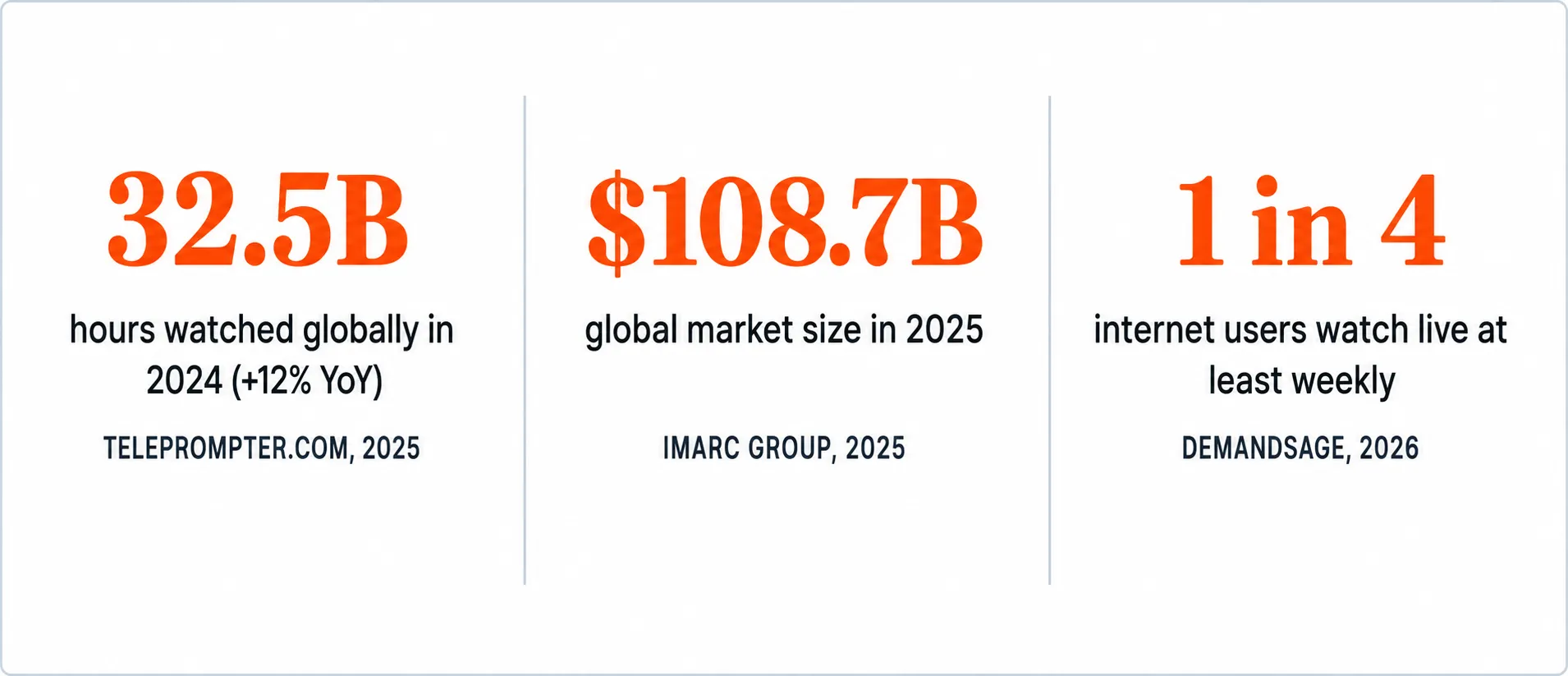
The headline numbers are striking on their own. The global live streaming market reached an estimated $108.7 billion in 2025 (IMARC Group, 2025), projected to grow at a 22.05% CAGR through 2034. Viewers worldwide watched 8.5 billion hours in Q2 2024 alone, with total watch time hitting 32.5 billion hours across the full year. Over one in four internet users watches a live stream at least once per week.
What those numbers obscure is that the industry is sorting into distinct tiers faster than ever. Platform economics are diverging. Creator revenue is more fragmented than the aggregate market size suggests. And the technology stack is undergoing its most consequential shift in a decade. This report covers all three.
How Big Is the Live Streaming Market in 2026?
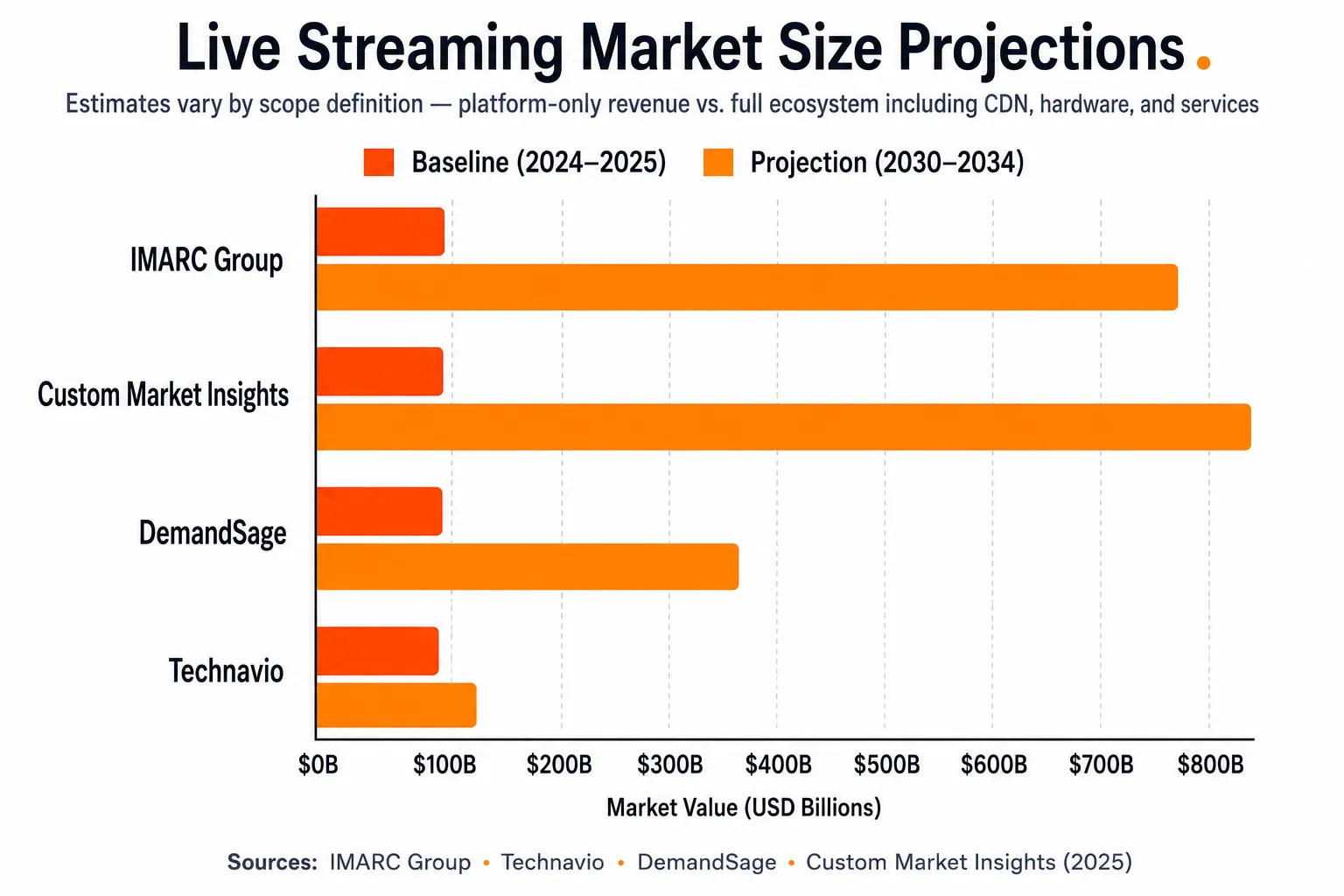
Market size figures vary enough to cause genuine confusion, and the variation is worth explaining. Estimates range from $99.82B to $108.7B depending on how the analyst defines scope. Narrower definitions count only platform revenues. Broader ones include CDN infrastructure, hardware, encoding software, and adjacent services. The chart below shows how four major research firms compare — none are wrong; they are measuring different things.
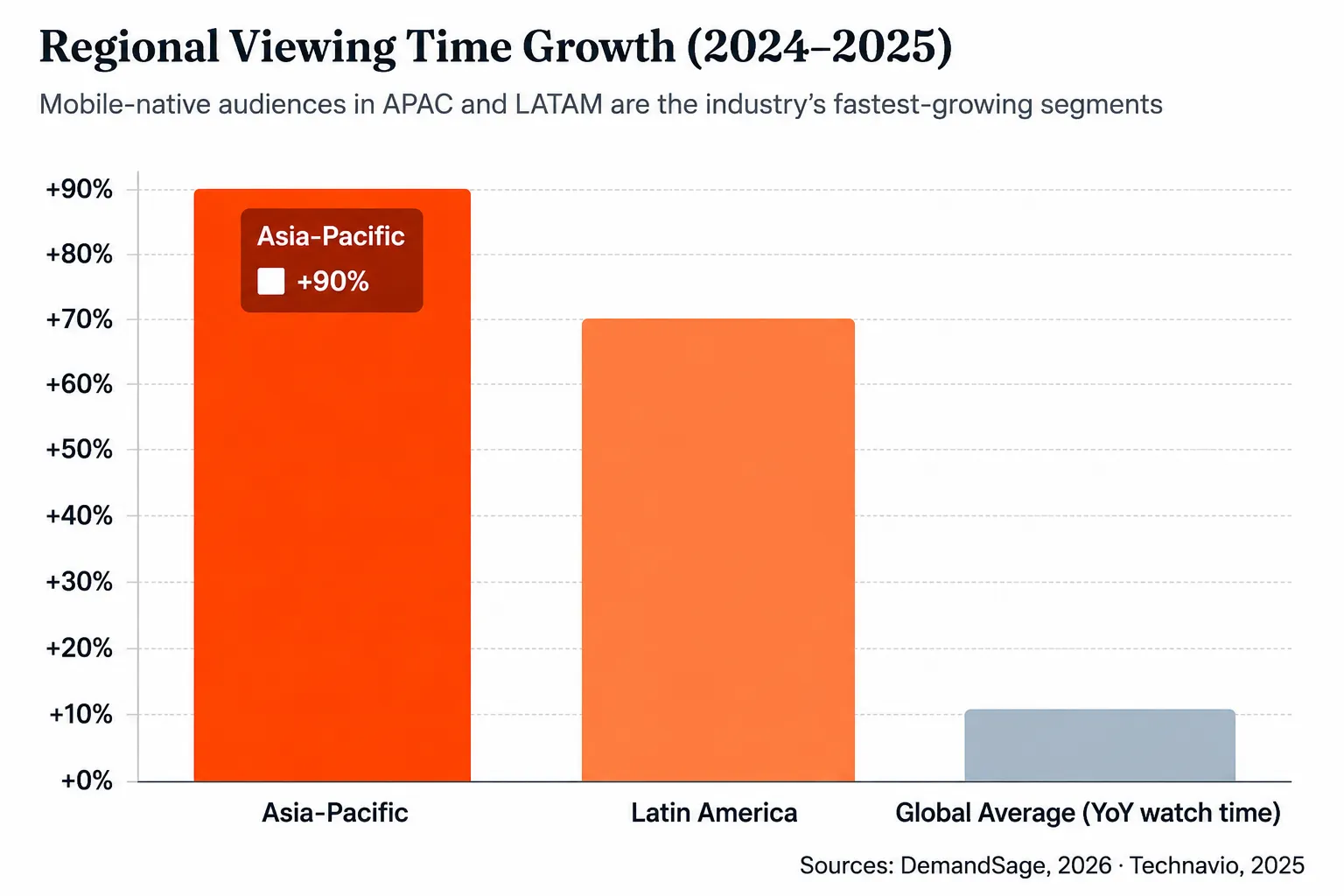
What is not disputed is direction and velocity. The live streaming industry is growing at roughly five times the rate of general internet advertising. Asia-Pacific commands approximately 49.8% of market growth (Technavio, 2025), and mobile viewing is the primary driver: Asia and Latin America recorded viewing time growth of 90% and 70% respectively in the most recent measurement period.
Platform Shifts: Who's Winning, Who's Losing Ground
Twitch's Loyalty Paradox
Twitch's core numbers remain imposing: 31 million daily active users, 7.23 million active streamers in Q1 2024, and a 53% share of the global esports audience (DemandSage, 2026). The platform's Just Chatting category reached 281.6 million hours watched in July 2023 alone, the clearest evidence that Twitch is a community infrastructure platform first and a gaming platform second. Yet the 50/50 revenue split for most affiliates remains a live grievance, and the platform has struggled to expand meaningfully outside gaming.
YouTube Live's Scale Advantage
YouTube is the most preferred live streaming platform globally, favored by 52% of viewers when given a choice of where to watch (DemandSage, 2026). In Q1 2024, YouTube streamed 41.5 million hours of new gaming content and 922 million hours of other live content. The structural advantage it holds is VOD discoverability: when a stream ends, it becomes a permanently indexed video receiving algorithmic recommendation traffic indefinitely.
TikTok Live and the Live Commerce Inflection Point
TikTok Live surpassing Twitch in total hours watched is not primarily a gaming story. It is a commerce story. TikTok Shop Live represents the most significant convergence of live broadcasting and e-commerce to reach Western markets, following the blueprint of Douyin, where live commerce has been a dominant retail channel since 2019.
The Platforms Most Articles Skip
Kick offers creators a 95/5 revenue split on subscriptions versus Twitch's standard 50/50, large enough to meaningfully change a mid-tier creator's take-home income. LinkedIn Live remains the most underutilized platform relative to its audience value, home to the highest purchasing authority of any streaming audience. Bilibili integrated AR features in October 2025, leading the APAC charge in feature innovation. Nimo TV anchors the Southeast Asian gaming audience within the same growth story.
Platform Comparison: Key Metrics at a Glance
| Platform | Revenue Split | Primary Use Case | Audience Profile | Multistream? |
|---|---|---|---|---|
| YouTube Live | Ad rev + Super Chats | Broad; VOD discoverability | Global, all ages | ✓ Yes |
| Twitch | 50/50 affiliates 70/30 partners | Gaming, IRL, community | 18–34, gaming-centric | ✗ Restricted* |
| TikTok Live | Creator fund + Shop | Live commerce, entertainment | 18–30, mobile-first | ✓ Yes |
| Kick | 95/5 creator-first | Gaming, IRL, alt-to-Twitch | 18–30, gaming | ✓ Yes |
| Facebook Live | Ad breaks + FB Shop | Community, live commerce | 25–45, broad | ✓ Yes |
| LinkedIn Live | Lead gen value | B2B, thought leadership | Professionals, 28–50 | ✓ Yes |
| X (Twitter) Live | Limited ad share | Breaking news, commentary | News, politics, 25–45 | ✓ Yes |
| Rumble | Ad share + subs | Alternative content | Political right, 30+ | ✓ Yes |
| Bilibili | Virtual gifting + subs | Gaming, anime, education | China/APAC, 18–30 | ~ Limited |
| Nimo TV | Gifting + sponsorships | Gaming (SE Asia) | SEA, mobile, 16–28 | ~ Limited |
Twitch restricts affiliates and partners from simultaneously streaming to competing live streaming services. Non-affiliated streamers are not bound by this policy.
Creator Economics in 2026: What Creators Are Actually Earning
The gap between the industry's $108.7 billion valuation and what a working creator deposits in their bank account is wide enough to deserve its own section. A Twitch streamer averaging 10 concurrent viewers earns roughly $50–$100 per month from Bits and channel subscriptions alone (DemandSage, 2026). A creator averaging 50 concurrent viewers earns approximately $200–$600 per month from platform-native monetization before any sponsorship or affiliate income.
Creator economy research from StreamElements suggests sponsorship CPM rates of $15–$50 for mid-tier streamers (1,000–10,000 avg concurrent viewers) in gaming and lifestyle streams, with B2B content commanding substantially higher rates. Creators who have broken through to $5,000+ monthly revenue almost universally describe a combination of two or three revenue streams rather than any single source generating the full amount.
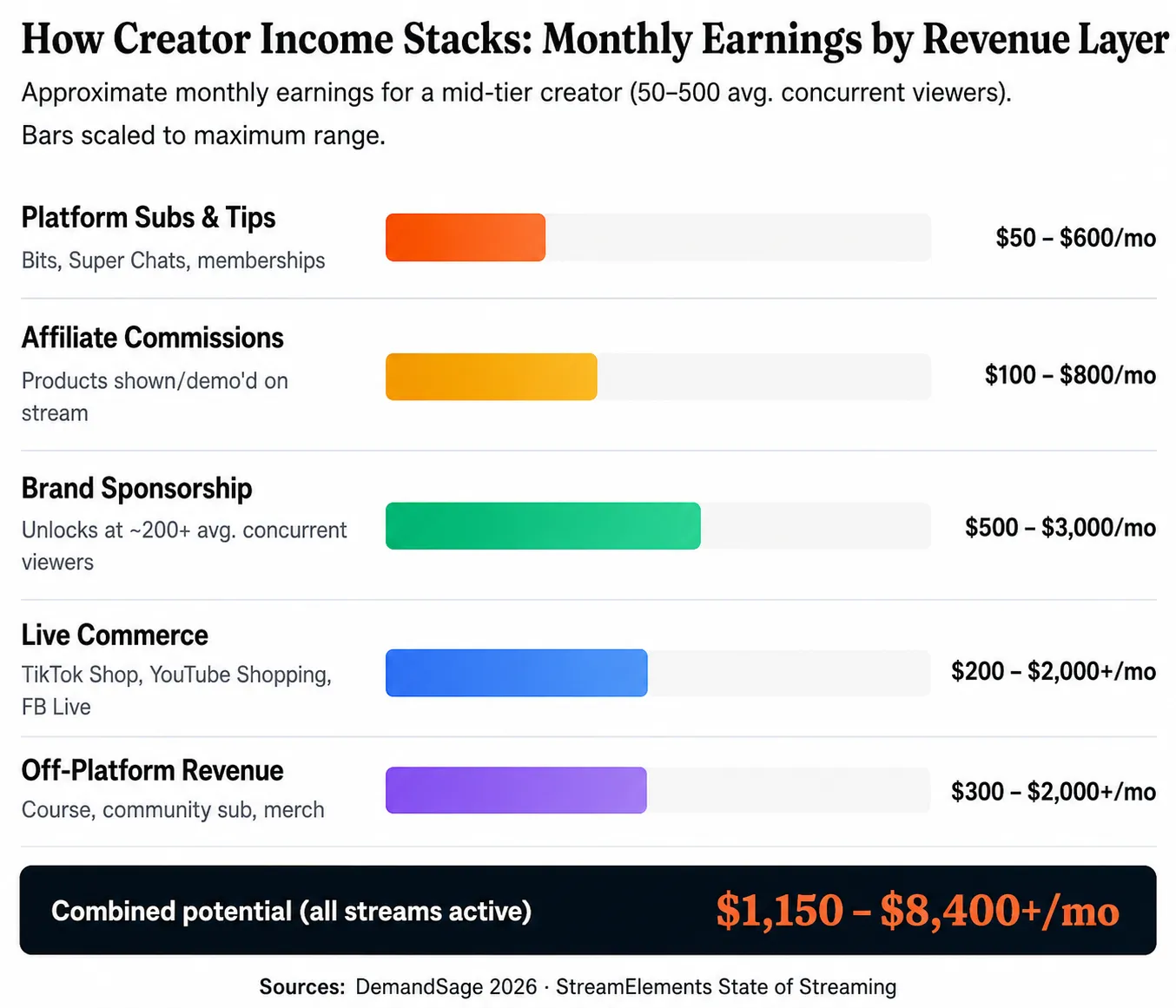
Every creator earning a sustainable living from live streaming in 2026 has built something off-platform. The platforms own the audience relationship during the stream; the creator who has built a direct channel owns the relationship permanently.
The Technology Shift Quietly Changing How Streams Are Built
The Codec Transition
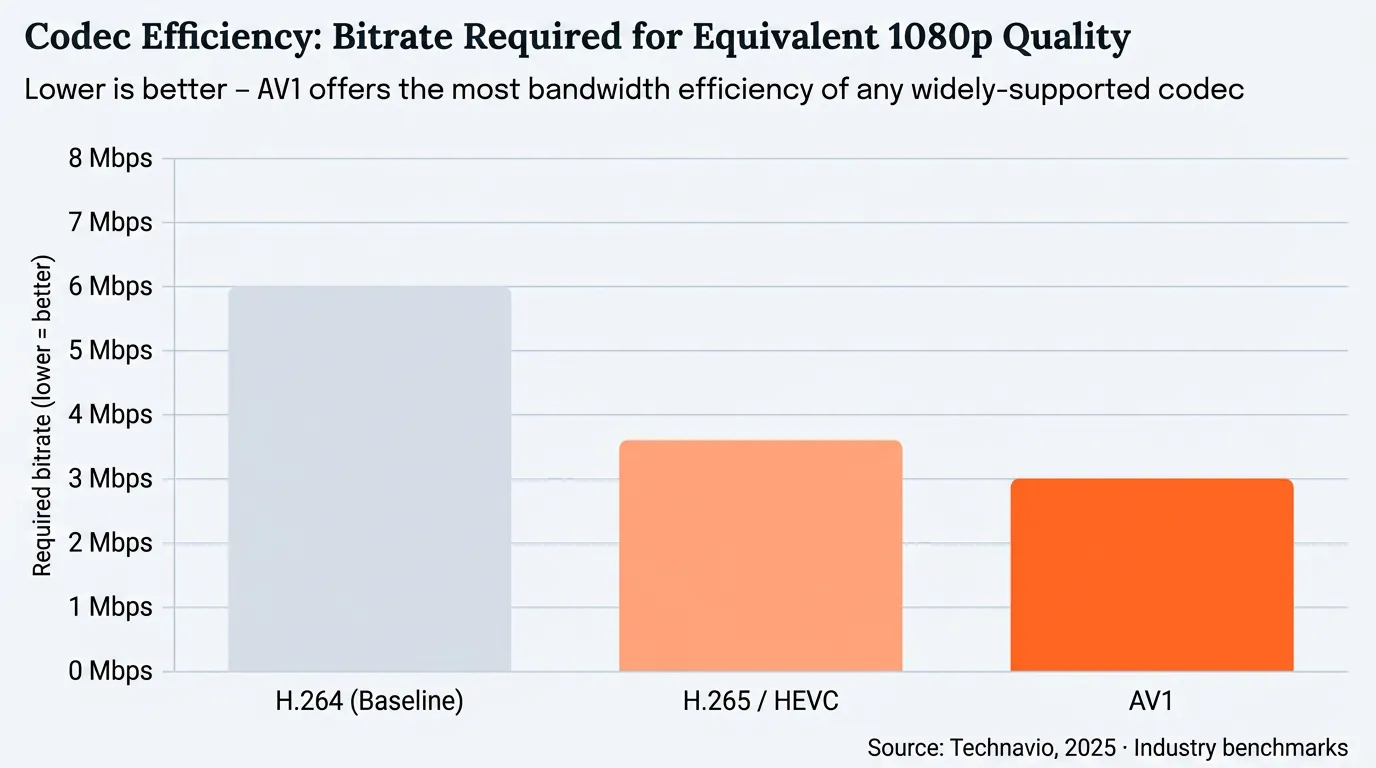
AV1, the royalty-free codec from the Alliance for Open Media, reduces bitrate requirements by up to 50% compared to H.264 at equivalent quality (Technavio, 2025). H.265/HEVC is the intermediate standard, already supported across most professional tools including vMix and OBS Studio. A creator streaming at 6 Mbps today could achieve the same visual result at 3 Mbps with AV1 support — a meaningful gain for creators on constrained upload connections.
Protocol Wars: RTMP, SRT, LL-HLS, and WebRTC
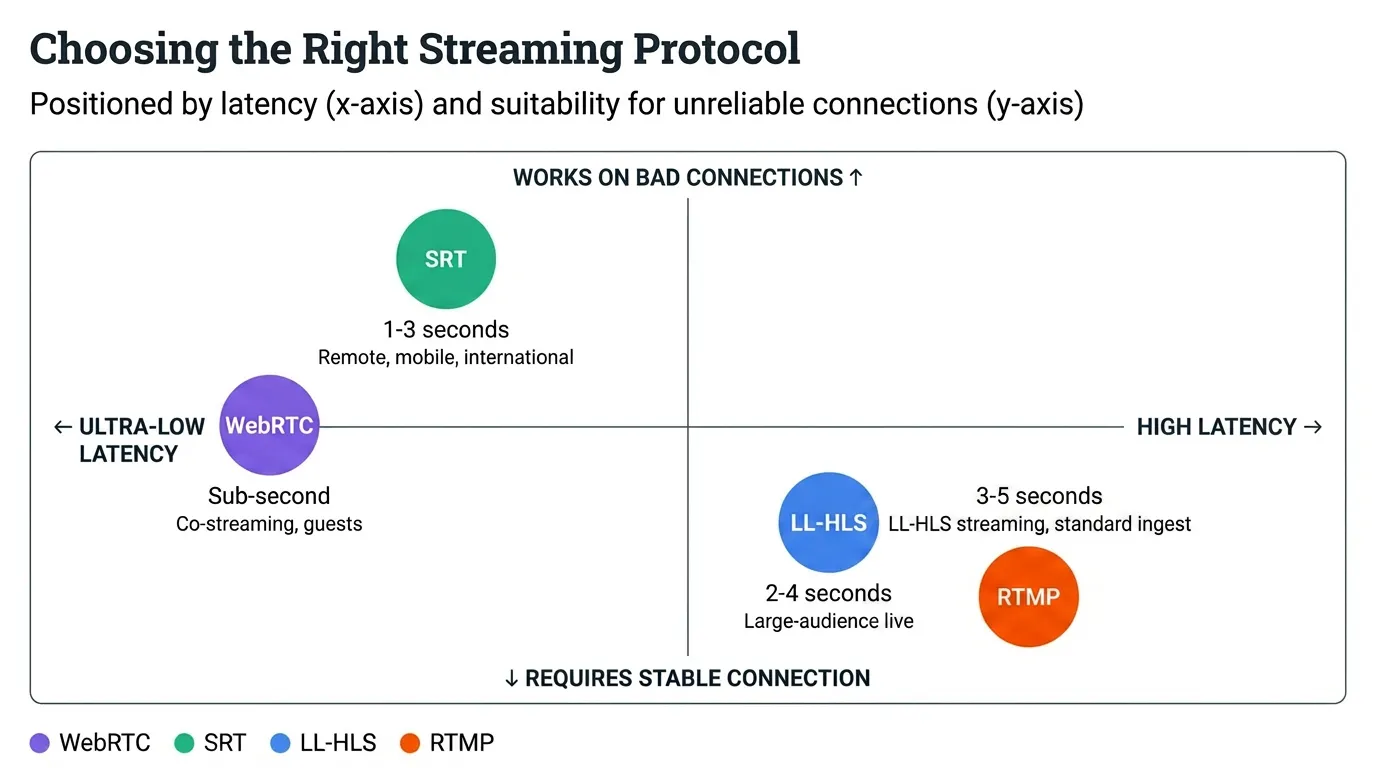
RTMP remains the dominant ingest standard — every major platform accepts RTMP, and it is the protocol underlying the vast majority of creator streams in 2026. Its longevity is a function of ubiquity, not technical superiority. SRT (Secure Reliable Transport) is gaining ground for its error correction on unreliable connections. LL-HLS reduces standard HLS latency from 10–30 seconds to approximately 2–4 seconds. WebRTC goes further with sub-second latency for collaborative formats.
💡 Quick Guide
For most studio-based creators on stable broadband, RTMP remains the practical default. Switch to SRT for remote or mobile broadcasts. Use WebRTC only for interactive co-streaming formats.
What's Coming Next: The Trends That Will Define 2027 and Beyond
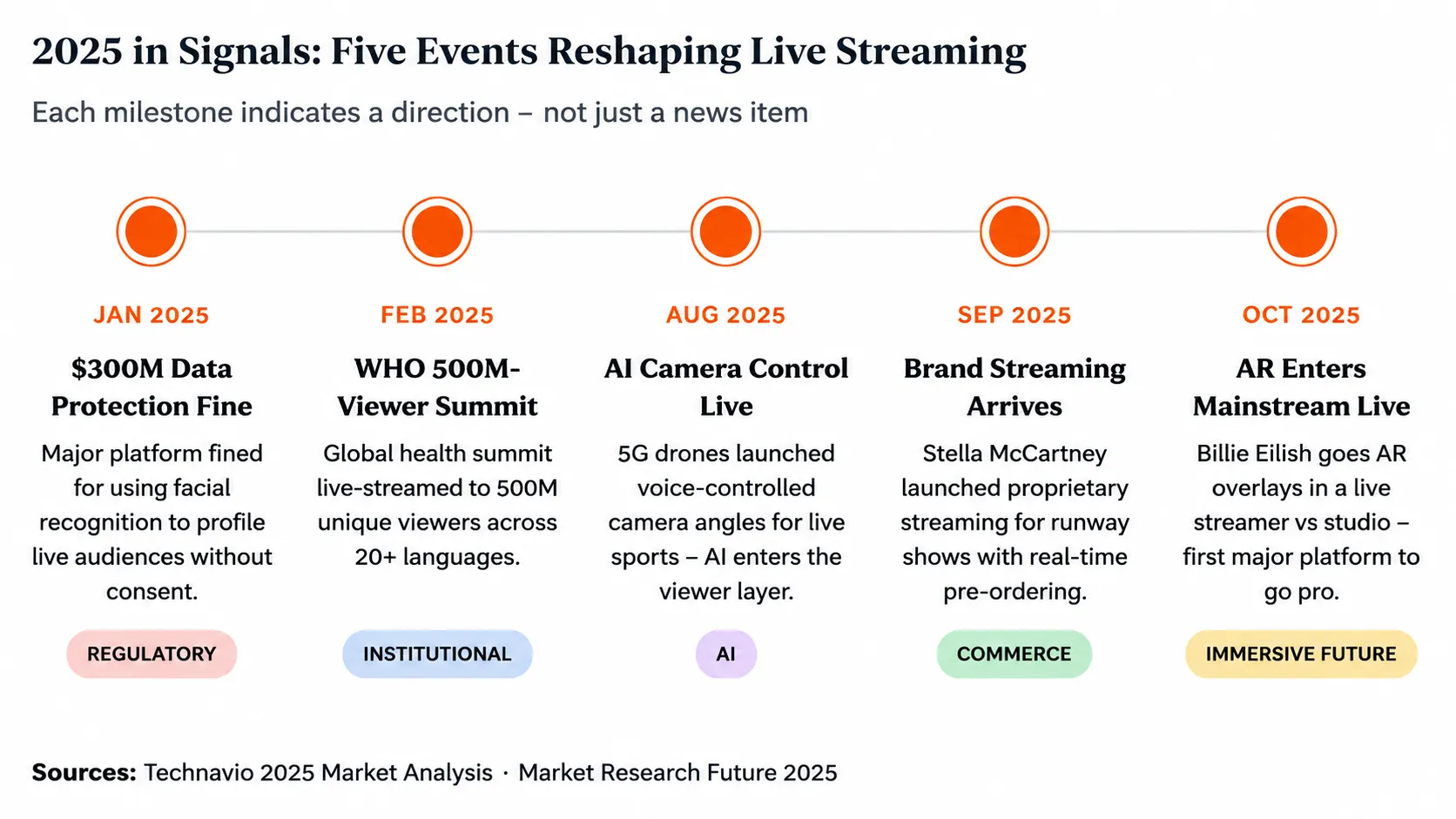
Live commerce is the defining expansion for Western live streaming in the next 18–24 months. The model is not experimental. Douyin demonstrated definitively that live shopping converts at scale when the creator has audience trust, the product category has visual appeal, and the purchase path has zero friction. Stella McCartney's September 2025 proprietary streaming platform launch is an early signal that brands with sufficient resources will bypass third-party platforms entirely for commerce-first live experiences.
The regulatory environment is tightening. In January 2025, a major social media platform was fined over €300 million by a European data protection authority for using facial recognition during live sessions without consent. DMCA enforcement remains an active and unresolved pain point. 5G's impact shows up most visibly in APAC and LATAM, where mobile viewing time grew 90% and 70% respectively — mobile streaming there is the primary workflow, not a fallback.
Is Multistreaming Worth It in 2026? A Practitioner's Take
"TikTok Live surpassing Twitch in total hours watched is not a gaming story. It is a commerce story — and most creator strategies haven't caught up to what that actually means."
The intuitive case for multistreaming is superficially compelling and practically flawed for most creators at the growth stage. The technical barrier has effectively disappeared: tools like Restream, StreamYard, Yostream, and Meld Studio have made simultaneous multi-platform broadcasting operationally trivial. The debate is no longer whether you can do it. The debate is whether you should.
The case against multistreaming for growth-stage creators is algorithmic. Each major platform rewards platform-native behavior. Twitch surfaces creators through clip virality within its own ecosystem. YouTube's algorithm amplifies live content to subscribers and compounds it as VOD. TikTok's For You Page builds momentum through platform-specific engagement signals. A creator who is simultaneously live on all three is optimizing for none of them.
Twitch's current policy as of mid-2026 restricts affiliates and partners from simultaneously streaming to competing services. YouTube has no equivalent restriction.
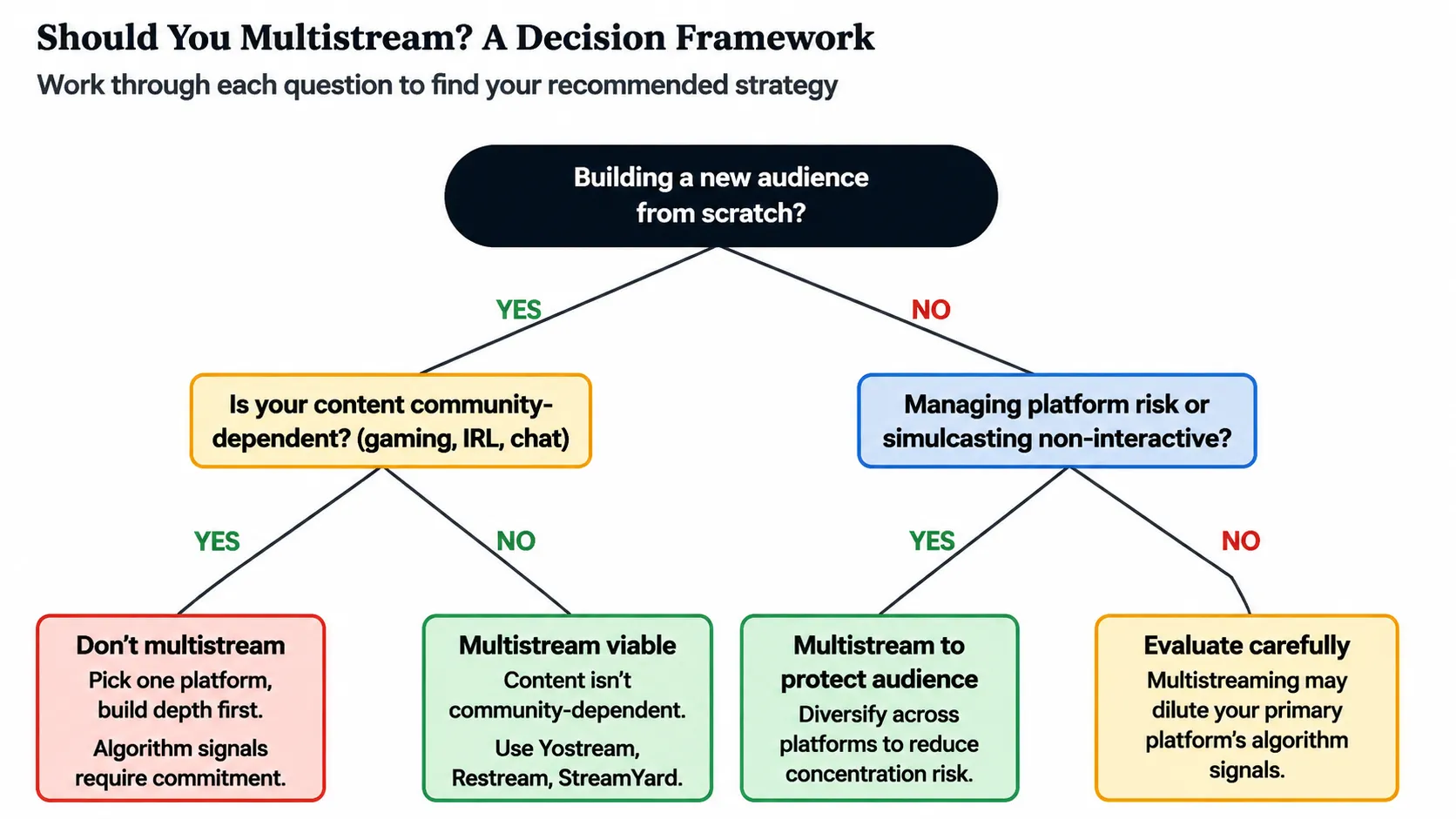
The technical capability to broadcast everywhere at once should not be confused with the strategic wisdom of doing so. For a creator under 500 concurrent viewers building a community, pick one platform and multistream only when you have an audience worth protecting.
Frequently Asked Questions
1. What is the live streaming market size in 2026?
The global live streaming market reached an estimated $108.7 billion in 2025 (IMARC Group, 2025) and is projected to grow at a 22.05% CAGR through 2034, reaching a potential $687.2 billion. Estimates vary: Technavio projects a $25.89 billion increase by 2030 at 17.9% CAGR, while DemandSage cites $345 billion by 2030. Differences reflect scope: platform-revenue-only vs. full ecosystem. Total watch time was 32.5 billion hours in 2024, up 12% from 2023.
2. Which live streaming platform pays creators the most in 2026?
No single answer fits all creators. Kick offers the best subscription split at 95/5 in the creator's favor. Twitch's standard is 50/50 for affiliates and 70/30 for select partners. YouTube has the most revenue mechanism diversity: memberships, Super Chats, Super Thanks, ad revenue, and Shopping affiliate commissions. Creators in commerce niches may find TikTok Shop Live or Facebook Live Shopping outperform all platform-native monetization through direct product sales conversion.
3. Is multistreaming allowed on Twitch and YouTube in 2026?
YouTube has no restriction — a YouTube creator can multistream to any platform without violating terms of service. Twitch restricts affiliates and partners from simultaneously streaming the same content to competing services. Non-affiliated Twitch streamers are not bound by this. Tools like Restream and Yostream facilitate multistreaming technically but do not override Twitch's contractual restrictions; creators should review their current Twitch agreement before configuring a multistream that includes Twitch.
4. What streaming software is best for beginners in 2026?
StreamYard is the most friction-free starting point — browser-based, no installation, built-in multistreaming. Streamlabs is best for gaming-focused Twitch streamers who want integrated alert systems. Yostream is built for creators who want built-in multistreaming without the complexity tax of desktop software. OBS Studio remains the most powerful free option for those willing to invest configuration time and who need granular encoder control.
5. How much can a small creator realistically earn from live streaming?
A Twitch creator averaging 50 concurrent viewers earns roughly $200–$600 per month from subscriptions and Bits (DemandSage, 2026). Sponsorships become meaningful at ~200+ concurrent viewers, with CPM rates of $15–$50 (StreamElements). Creators reaching $2,000+/month from streaming alone are a small minority; the pattern among those creators is diversification across platform subscriptions, sponsorships, and at least one off-platform revenue stream.
Dive Deeper:
- $0 price tag: 5 Free Tools That Make Your Stream Look $10K Professional
- The setting 90% of streamers ignore: The One Audio Setting That Separates Pro Streamers from Beginners
- Grow live without ad spend: How to Grow from 0 to Your First 100 Live Viewers (No Ad Spend)
- Broadcast HD live: 6 Best Live Streaming Software for HD Broadcasts With Minimal Lag (2026)